

Every fortnight, we’ll try to communicate all that’s happening with R4R from an internal perspective, to help you understand what we’re doing and why we’re doing it, so you can enjoy the ride, help us correct-course, or put your shoulder to the wheel.
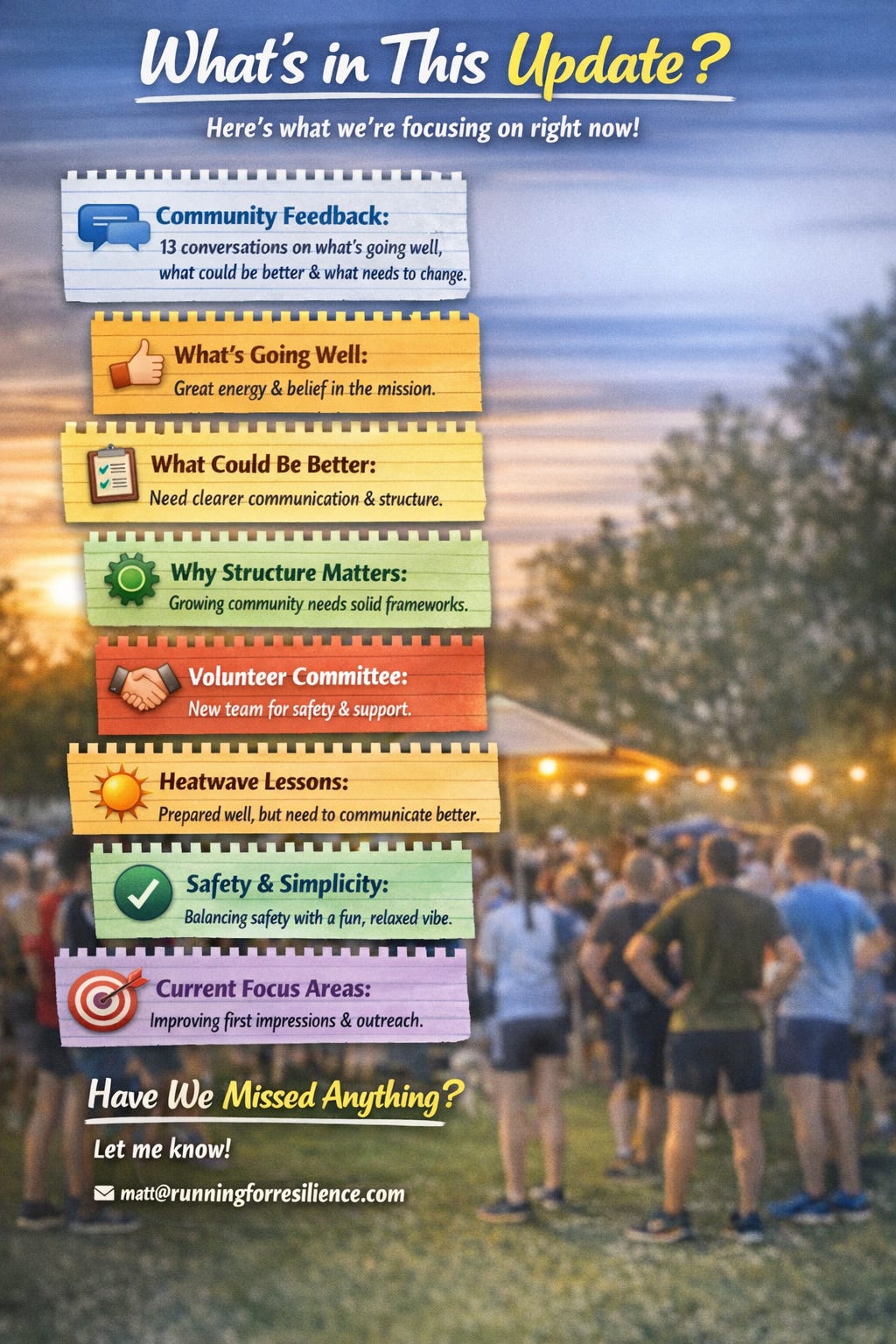
What’s in this update:
Community Feedback:
13 conversations gathered input on what’s going well, what could be better, and what needs to change.What’s Going Well:
The energy, atmosphere, and belief in the mission remain the strongest parts of R4R.What Could Be Better:
The main request from the community is clearer communication and stronger organisational structure.Why Structure Has Become Important:
Our community-led, flexible approach has worked well, but growth now requires clearer frameworks to support more people getting involved.Volunteer Committee:
A new committee has been formed to improve safety processes, strengthen our welcoming culture, and better support volunteers.Recent Heatwave Example:
Operationally we were prepared, but the situation showed we need to communicate our safety processes more clearly.Balancing Safety and Simplicity:
The goal is to stay well prepared behind the scenes while keeping events relaxed, welcoming, and fun.Current Focus Areas:
We’re improving first impressions across website, social media, and events through an upcoming targeted deep-focus session.
Want to know more?
Feedback
I’ve had 13 separate conversations with R4R stakeholders recently, and the conversations centre around three questions. What’s been going well, what could be better, what do we need to change.
If you’d like to have a conversation and provide your feedback, please email me at matt@runningforresilience.com
What’s been going well
The overwhelming feedback for what’s going well is the energy and atmosphere in our community. People love being part of our mission and believe it’s possible… But as the questions are designed to find out, it’s not all beer and skittles.
What could be going better
The clear theme for what could be better is more communication and better structures. We’ve put a fortnightly email, organisational structure, and floating to-do list in place to address this, and this feedback is likely to lag on those changes.
Structure and communication
Why have we bumped into the problem of people wanting more structure and communication?
One of our principles is being community-led.
Historically, this has meant we’ve lowered almost all barriers for people to put their shoulder to the wheel, under the assumption that we need thousands of leaders in Canberra, modelling the behaviours conducive for a suicide-free Canberra.
What this has meant is a very flexible approach guided by a goal, a belief, and a set of principles.
And while this is very clear to some, underneath it all is a void where people who thrive in ambiguity succeed, and people who like frameworks might find themselves uncomfortable.
R4R has reached a point where we need both.
An opportunity for people to continue experimenting as leaders of R4R, while building structures that clearly guide effort from those willing to give it, but just want to make sure they’re doing the right thing.
Believe it or not, this pain is a good thing.
It’s a sign that we’re growing and that we’ve got so many shoulders to the wheel that we need to start organising efforts in a more purposeful way.
Fortunately, the community-led approach persists because the changes we need to make are clearly defined by our community. Better structures, better communication.
Volunteer Committee
The volunteer committee has been stood up, and the purpose of the committee is to help implement safety protocols, to facilitate a welcoming environment at events, and to help our volunteers have fun contributing to our mission.
These goals were somewhat tested on a scorcher of a Wednesday night last week, highlighting where we can be better.
Better processes. More Awareness.
Because we don’t force people to run, we give instructions around the heat, make an additional effort to provide water, and have a presence of volleys who can contact emergencies if needed, there wasn’t much that needed to be done.
We’ve got hundreds of events with more than 100 people in our back pocket, we’ve got a great group of people that have been contributing to our safety posture, we’ve sought legal and safety advice, and we’re always looking at best practice.
In other words, we were aware, but we thought we were sweet.
But because this wasn’t clearly articulated to the broader community, either in the moment or during an onboarding process, it generated stress amongst some, and fair enough… in ambiguity and in extremes, creeps stress.
This stems back to communication and hopefully the changes we’ve made will address it.
Keeping it Simple. Keeping it fun.
Wednesday night is… dare I say it… one of the largest mid-week running events in Australia, and as such, is the perfect environment to sharpen our processes so they can be rolled out to other events where necessary.
We want our events to be safe and at the same time, we want to make sure we’re not governed by worst-case scenarios and anxieties, because this changes the welcoming and fun nature of our community.
And fortunately, as much as it might be hard to believe for some, safety and fun can complement each other.
Prepare, prepare, prepare, wing it.
When I’ve got a speech I need to do, I’ll write extensively, I’ll practice bits of it out loud, and I’ll refine it into key dot-points I know I can remember.
I prepare lots, but when it comes time to speak, I’ll go without notes and read the room, speaking to them rather than performing, and trusting the work I’ve done and the structure I’ve given myself will drag me through.
And I think this is where we can find the balance with safety and simplicity.
As one of our safety committee members said, if we can work behind the scenes to have simple structures and extensive preparation for what could happen and how we would respond, then it allows us be relaxed when push comes to shove.
In other words, to keep everything fun and relaxed, we need to be prepared behind the scenes.
Something we’re doing:
A handful of us are making some time to dedicate our attention to first interactions. Whether it be our website, social media, or events… first impressions matter, and they can be important in welcoming someone who’s struggling.
This will be the first of many deep focus sessions where we pick one task or problem and bang our heads together to fix or improve it.
Have we missed anything?
I’ll do my best to cover the salient happenings within R4R and why, but with all the moving parts, I’ll inevitably miss something.
If you’d like more explanation on something or you have any feedback, please email me at matt@runningforresilience.com or comment directly here.
The tension between staying nimble and adding structure is such a common growth challenge. The 'prepare extensively, then wing it' approach to safety makes sense, it keeps the experience spontaneous while having protocols ready. The lag between implementing changes and feedback catching up is real too. People often provide input based on past experience not current state. Clear onboarding could help close that gap faster.